
On reviewing FieldLark, we were shocked to discover that John Kempf was its #2 user. Who on Earth could have asked more questions of FieldLark than its creator?
We tracked him down and he agreed to sit for an interview with us.
Meet Dave from Australia.
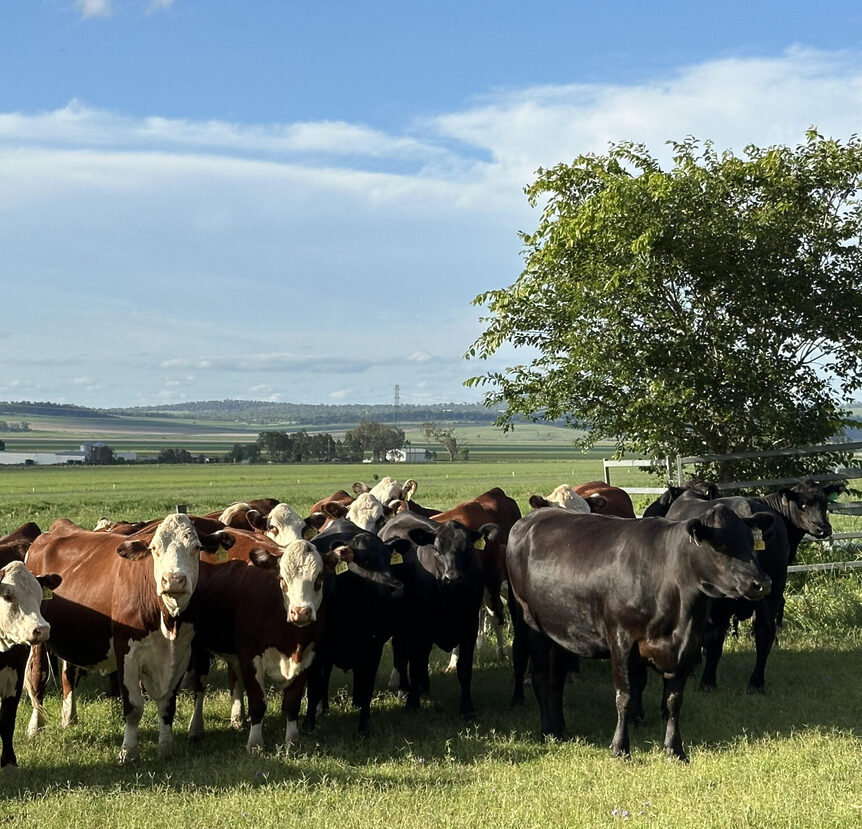
In addition to being FieldLark’s #1 user, Dave is an Australian cattle rancher in his mid-30s (Dave asked us to withhold his last name for privacy). Together with his father, he grazes 1300 Angus breeders on about 15,000 acres in Northern New South Wales, Australia.
Dave’s mindset has always inclined towards soil health, but that revved into high gear when the family moved to their current properties, which are both lower fertility and more intensely-grazed than where he grew up, in the vaster rangelands out west.
“One of the places that we bought is a bit run down in fertility and past use of conventional practices has gotten the soil’s functions out of whack. So we really need to change them quickly. I think that’s why I’m such a prolific user [of FieldLark]. I’m really trying to get results as quick as I can and get up to speed with all of this.”
Dave’s regenerative journey led him to complete a weeklong “Grazing for Profit” course through RCS, and of course, the Regenerative Agriculture podcast. But he hasn’t found the support he’s needed to put the principles into practice in his specific context.
“I just haven’t come across an agronomist here that’s aligned with what I’m trying to achieve. I’ve been doing sap analysis for the last year, and needed interpretation. I found it very hard to find agronomists here that are willing to go down that route. They’ve got their own methods of doing things and it’s sort of cookie cutter . . . I can see there’s a different way of doing things, but it’s a little bit out of focus how to do it. [FieldLark] really brings it into focus.”
Dave has used ChatGPT since it came out, and so was fairly experienced with LLMs before FieldLark. But he’s found FieldLark to be a big improvement over ChatGPT.
“It’s got ground-truthed data and context behind it, which gives you a bit more confidence in what it’s saying. With ChatGPT, it feels like it’s just pulling things from the internet. . . . And that’s a bit different to the data that FieldLark has. There’s more data points there.”
For instance, Dave asked both LLMs about rates of molasses. ChatGPT suggested a maximum rate; FieldLark’s suggested rate was twice that.
When using LLMs, Dave says “The most important thing is knowing how to ask the questions. I’ve asked pretty much the same question twice, but left out a tiny detail and I’ve gotten different answers. For example, with a urea foliar, I’ve asked it ‘What is the highest concentration I can spray without getting phytotoxicity?’ And in another chat, I’ve asked the same question, but I’ve included humates as part of that mix. And it’s given me completely different ranges of concentrations. Now, if I was a beginner and I didn’t know anything about humates and just asked about urea, well, I’d be stuck with that lower concentration, which would probably give me a poorer result.”
In this way, AI serves as an augmentation to human intelligence: it’s vastly more powerful when a person has the background knowledge and experience to ask the right question.
Dave has found FieldLark most useful in solving the really complex problems: combining sap analysis with soil tests and other context. “I think I’d be capable of analyzing each one of those by themselves, but how they intersect is really complicated unless you’re a highly-trained agronomist. Add in all the interactions between the different minerals . . . it does your head in trying to do it yourself, but FieldLark can spit it out in two seconds.”
FieldLark truly works as an AI agronomist for Dave. “I can get an understanding of why it’s saying what it’s saying as well. That’s the best thing: it can give you the results and then you can ask it 50 questions, which I’d be loath to do to an agronomist and take up days of their time.”
Dave gives the caveat that he’s in the early stages of implementing FieldLark’s advice, so doesn’t yet have data on its outcomes. “However I have asked it about practices I’ve had great success with in the past, by prompting it as if it was my first time considering them, and FieldLark thought it was a great idea. Examples like that give me confidence.”
We asked Dave how he feels about being FieldLark’s #1 user. He laughed. “It makes me think I should probably get off it a bit.”
Subscribe to get each post right to your inbox.
You'll get each post to your inbox (~1x/week).
You may unsubscribe at any time. We value your personal information. Here's our Privacy Policy.
"*" indicates required fields